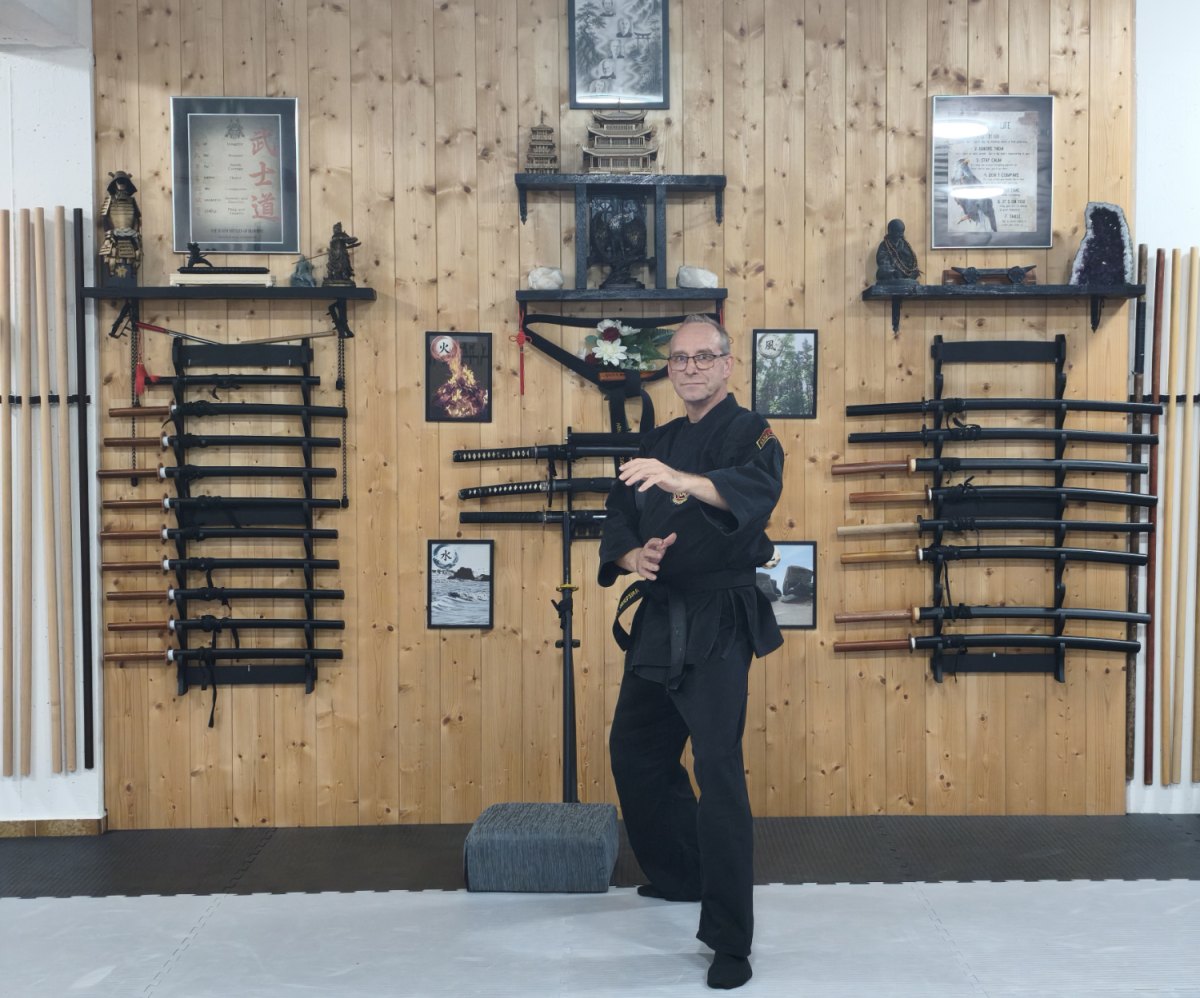
Shidoshi-Ho Arnout Griepsma
Sandan: Shinden Fudo Ryu Course“My journey in Ninjutsu began in the Netherlands more than 25 years ago.”
My Story in the IBDA
My journey in Ninjutsu began in the Netherlands more than 25 years ago, under a Shihan of Sōke Masaaki Hatsumi whose teaching was strongly rooted in the older, pre-1990s approach to Ninjutsu.
From the beginning, meditation and mental training were integral parts of the art alongside intensive physical practice. This combination of body, awareness and mind has influenced my understanding of Budō ever since.
For many years I trained several evenings every week and regularly spent weekends in the dojo, seminars or additional training, while working long hours as an entrepreneur running several retail businesses. Training was therefore not simply something I found time for; it was a conscious choice and a priority in my life.
I also have asthma, which could make intensive physical practice more demanding, but it never stopped me from training. I spent countless hours working with instructors and training partners: repeating techniques, receiving corrections, working against resistance, exploring distance and timing, making mistakes and learning through direct experience.
I studied different martial arts and reached high levels in several disciplines. My understanding of Budō therefore developed primarily on the mat.
I also travelled to Japan and attended a class taught by Sōke Masaaki Hatsumi. My direct training time with him was brief, but experiencing firsthand how he taught and, particularly, how he moved was important to me.
Throughout my journey I have trained and studied under several Shihan who learned from Hatsumi during different periods and developed different ways of transmitting his Budō.
The same technique or principle can feel completely different depending on the teacher. One may emphasize structure and precise technique, another distance, timing, natural movement, flow, strategy or mental development. Having seen Hatsumi himself move and teach made me increasingly interested in understanding these different interpretations.
I was never particularly interested in deciding which was “correct.” I wanted to understand what each Shihan had recognized and preserved from Hatsumi's teaching — and what underlying principles connected their approaches.
That search brought me to Doshi Richard Van Donk and the International Bujinkan Dojo Association in 2018.
By then I already had many years of intensive hands-on dojo experience. I was not looking for a new starting point, but another perspective from which to examine what I had physically learned.
This is where Doshi's teachings became particularly valuable to me. The IBDA added an enormous amount of theoretical knowledge to my practical background. History, terminology, strategy and underlying principles gave context to material I had already trained physically and revealed connections between subjects that can otherwise appear separate.
I can study something through the IBDA, take it onto the mat, physically test it and compare it with what I learned from other teachers. For me, theory does not replace physical training; it gives context to it. Understanding why we do something changes the way we practice how we do it.
In October 2025, I reached Shodan within the IBDA and became a Shidoshi-Ho under Doshi Richard Van Donk. This marked an important step in my continuing study and brought a new responsibility: to keep developing my own understanding while passing on what I have learned with respect for the teachers and traditions that contributed to it.
My journey also influenced a major change in my life: moving from the Netherlands to Tuscany, Italy. Cleaner air was important because of my asthma, but I also wanted to live and train closer to nature.
Earth, Water, Fire, Wind and Void had been part of my martial arts and meditation training for many years. Living among the mountains, forests, rivers, changing weather and seasons of Tuscany gave me the opportunity to experience those concepts beyond the dojo.
Italy also gave me the freedom to create my own dojo. Today I run Budojutsu Academy, where I continue to train while teaching adults and young people.
Ninjutsu remains my martial foundation and continues the path I started in the Netherlands.
Kamaejutsu grew from my physical practice and my interest in what happens between techniques. By removing the combative element, I can focus on kamae, balance, weight transfer, movement and especially flow: moving naturally from one kamae into another without unnecessary interruption or loss of balance.
Godai Meiso continues the meditation and mental training that were integral to my earliest Ninjutsu years, now connected more directly with the natural environment in which I live.
Hichi Buko Goshin Jutsu is one of the more recent additions to my own training, adding another perspective on posture, balance, movement and the way the body functions as an interconnected whole.
Budojutsu Academy has become the place where these different parts of my journey come together. Teaching also tests my own knowledge: explaining and demonstrating something quickly reveals whether I truly understand it myself.
The IBDA is an important part of this continuing journey. I am grateful to Doshi Richard Van Donk for his trust, guidance and the knowledge he continues to share.
More than 25 years after first stepping onto the mat, I still consider myself a student.
Walk. Learn. Repeat. Inspire.
Arnout Griepsma
IBDA Shodan — Shidoshi-Ho
Budojutsu Academy
Tuscany, Italy
START YOUR OWN STORY